
One of the most common — and most expensive — ambiguities in solar procurement is the word "bracket". A buyer asks for solar panel mounting brackets, a supplier quotes a price per piece, and the two parties believe they are discussing the same thing. They usually are not. One is pricing a fixing component; the other needs a structure that will stand in 50 m/s wind for 25 years.
This article draws a clear line between a solar mounting bracket and a solar racking system, explains where each is appropriate, and shows how to write a specification that prevents the wrong assumption from reaching the quotation stage.
What is the short answer: bracket or racking system?
A solar mounting bracket is a single-point fixture, while a racking system is the engineered framework that carries an entire array and transfers its loads to the ground or roof. Qingdao Develop Group's AHSS+ZAM racking uses ≥700 MPa steel with 5,040 hours of salt-spray resistance (ISO 9227) and a 30+ year design life.
A mounting bracket is a single-point fixture that attaches a module or rail to a surface. A racking system is the complete, engineered framework that supports an entire array and transfers its loads safely to the ground or roof. Brackets are parts of racking systems — but a box of brackets is not a racking system.
What Is a Solar Panel Mounting Bracket?
Solar panel mounting brackets are single-point hardware — L-feet, Z-brackets, tile hooks and clamps — used at individual attachment points on small or retrofit arrays of one or two modules. For coastal sites, Qingdao Develop Group supplies ZAM-coated brackets with 5,040 hours of salt-spray resistance (ISO 9227), but they still do not form a certified racking system.
Solar panel mounting brackets are discrete hardware items used at individual attachment points. Common types include:
- L-foot brackets — connect rails to a roof deck or purlin.
- Z-brackets — offset brackets for walls, fences and vertical surfaces.
- Tile hooks — anchor rails to pitched tile roofs without penetrating the tile where possible.
- Mid-clamps and end-clamps — hold modules to rails without drilling module frames.
They are normally purchased in quantity for small installations, DIY arrays, signage, RVs, or as replacement and expansion parts within an existing system. Their unit price is low, and they are usually sold without structural certification as a standalone assembly.
What Is a Solar Racking System?
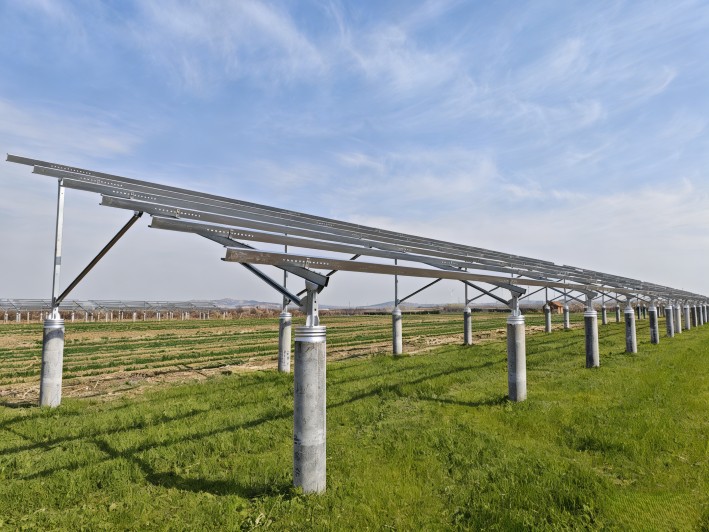
A solar racking system is a complete structural solution — foundation, posts, beams, rails, clamps and bonding — whose load path is engineered and documented from module frame to ground. Qingdao Develop Group specifies AHSS+ZAM at ≥700 MPa with 5,040 hours of salt-spray resistance (ISO 9227), designed for 25–30+ years and certified per-site wind and snow loads.
A solar racking system is a complete structural solution: foundation, posts, beams, rails, clamps and bonding hardware, designed and tested to work together. Its defining feature is not the number of parts but the fact that the load path is engineered and documented — from the module frame, through the clamps and rails, into the foundation, and ultimately into the ground or building structure.
Racking systems are specified by project-level parameters: design wind speed, snow load, array geometry, corrosivity category and service life. If you want a component-level breakdown, our guide What Is a Solar Racking System? covers each part in detail.
How do mounting brackets and racking systems compare side by side?
| Dimension | Mounting Bracket | Racking System |
|---|---|---|
| Scope | Single fixing point | Complete structural assembly |
| Typical application | 1–2 modules, small or retrofit installs | Multi-module arrays, utility and commercial projects |
| Engineering | Usually none supplied | Load calculations, connection details, certifications |
| Foundation | Not included | Piles, ground screws or ballast included |
| Wind uplift rating | Seldom stated | Tested and documented |
| Pricing basis | Price per piece | Price per watt or per MW |
| Service life | Depends on coating and site | Designed for 25–30+ years |
A rule of thumb for specification
Small installations need brackets; arrays need racking. If the array must be permitted, insured, or qualify for tax credits, assume a certified racking system is required until the authority having jurisdiction confirms otherwise.
When should you choose a mounting bracket?
- One or two panels on a balcony, shed, fence or RV.
- Replacement or expansion of an existing array where the original structure is intact.
- Light-duty applications with no permit or structural sign-off requirement.
- Situations where you are supplying components to an installer who already owns a certified structure.
When should you choose a racking system?
- Commercial or utility-scale ground-mount projects.
- Any installation requiring building permits, structural calculations or wind certification.
- Coastal, high-wind, heavy-snow or high-seismic sites.
- Projects with a 25-year performance guarantee or power purchase agreement.
Why does material choice still matter for brackets and racking?
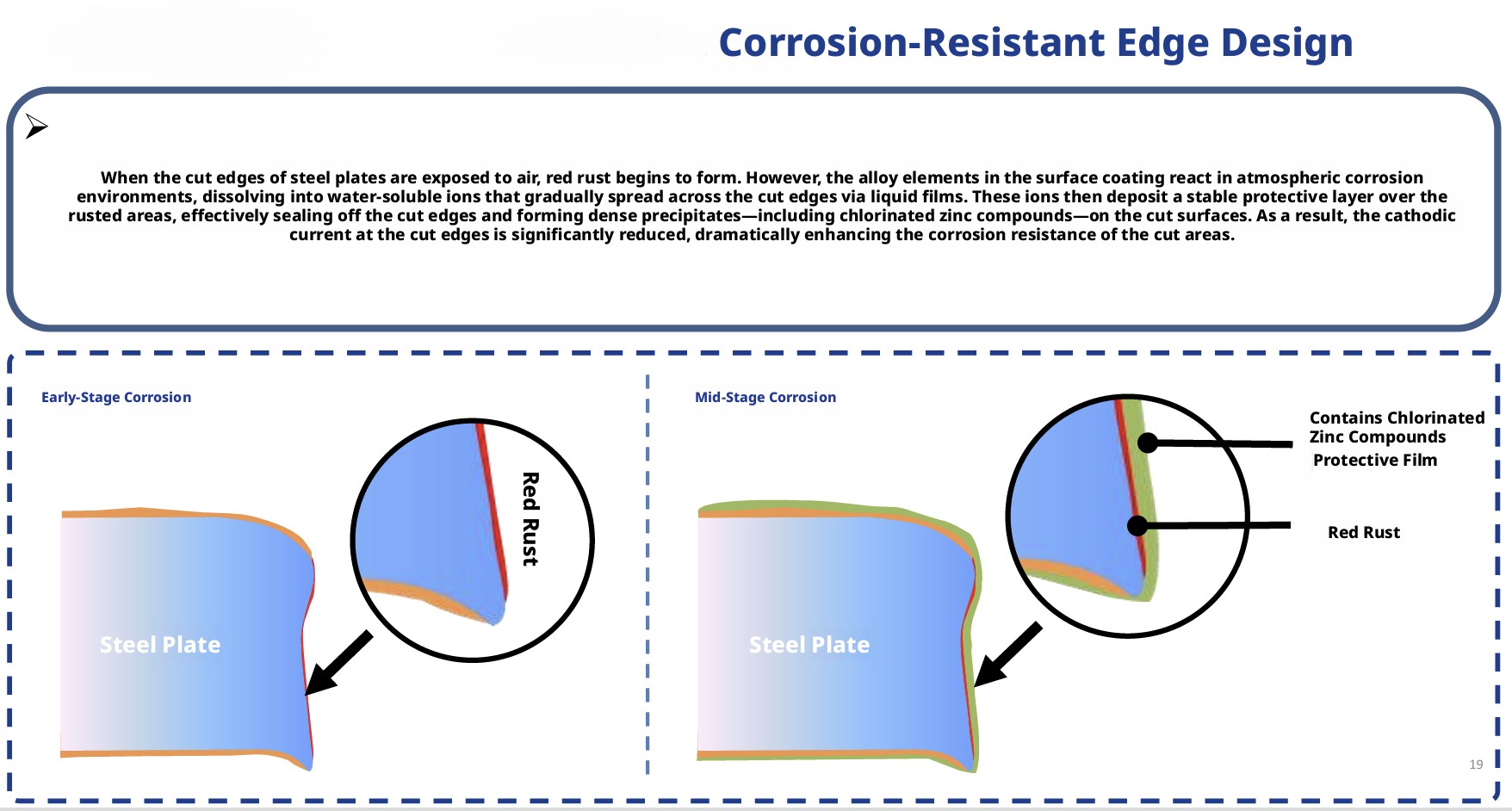
ZAM steel matters for brackets and racking alike because small components have high surface-area-to-thickness ratios and many cut edges that corrode first in coastal air. Qingdao Develop Group's AHSS+ZAM coating reaches 5,040 hours in ISO 9227 salt spray versus about 800 hours for HDG, self-heals at cut edges and supports a 30+ year service life.
Even when a project only needs brackets, material quality determines how long the installation survives. Small brackets have a high surface-area-to-thickness ratio and plenty of cut edges — exactly the features that corrode first in a coastal atmosphere.
ZAM steel across both scopes
Qingdao Develop supplies both individual mounting components and complete AHSS+ZAM racking systems. The Zn-Al-Mg coating reaches 5,000+ hours in ISO 9227 salt spray testing and self-heals at cut edges and bolt holes — the points where conventional hot-dip galvanizing fails first. High yield strength also allows thinner, lighter sections without sacrificing load capacity.
How do brackets and racking differ in cost and procurement?
Qingdao Develop Group advises comparing brackets and racking on delivered cost per watt, not piece price versus watt price. Define the scope and design wind speed in writing, then request the bill of materials with steel grade and coating. Its AHSS+ZAM racking uses ≥700 MPa steel for 20–25% lower installed bracket cost and a 30+ year design life.
Comparing a per-piece bracket price with a per-watt racking price is meaningless. To compare quotations fairly:
- Define the required scope in writing — components only, or a complete certified system.
- State the design wind speed and corrosivity category.
- Request the BOM with material grade and coating specification for every structural member.
- Ask what engineering documentation is included with the quote.
- Compare delivered cost per watt, including foundation hardware and installation labour.
Doing this consistently is the fastest way to avoid the classic procurement error: accepting a low bracket price for a project that actually needed an engineered structure.
Need a Mounting System Sized for Your Site?
Send us your array layout, site location and design wind speed. Our engineering team will return a preliminary specification and ZAM steel quotation within 48 hours.
Get a Free Mounting Assessment →Frequently Asked Questions
What is the difference between a solar mounting bracket and a racking system?
A mounting bracket is a single-point fixture such as an L-foot, Z-bracket or tile hook used for one or two modules. A racking system is the complete engineered assembly — foundation, posts, rails, clamps and fasteners — rated to carry a distributed load across an array. Brackets are components; racking systems are structures.
Can I build a large solar array using only mounting brackets?
Technically you can assemble an array of one or two modules from brackets and rails, but beyond that the load path, wind uplift and code compliance have to be engineered as a system. For permitted, insured or utility-scale installations, a certified racking system is the correct specification.
What is a Z-bracket used for in solar mounting?
A Z-bracket is an offset steel bracket used to attach solar modules or rails to a wall, fence or roof surface, creating stand-off clearance and an air gap. It is a single-point mounting component, not a complete racking solution.
Is UL 2703 required for brackets or only for racking systems?
UL 2703 covers mounting systems, mounting devices, clamps and racking systems as a bonded assembly. In most US jurisdictions a permitted grid-connected installation requires listed components; specifying individual brackets without a listed system can complicate inspection and insurance.
Does ZAM-coated steel make sense for small bracket applications?
Yes — in coastal or high-humidity sites ZAM-coated brackets reach 5,040 hours of salt-spray resistance (ISO 9227), and their self-healing coating protects cut edges and drill holes where small brackets corrode first. That is why ZAM is specified even for individual mounting components in aggressive environments.
References
- ISO 9227 — Corrosion Tests in Artificial Atmospheres, Salt Spray Tests
- ISO 9223 — Corrosivity of Atmospheres and Classification
- ASCE 7 — Minimum Design Loads for Buildings and Other Structures
- UL 2703 — Mounting Systems, Mounting Devices, Clamps and Racking Systems
- How to Choose a Solar Mounting System — Qingdao Develop Group
- Solar Mounting Product Range — Qingdao Develop Group